
EOTP - Promoting Civil Online Learning Environments
Rationale
Paff (2015) writes, “To develop students as independent and mature learners, teachers need to go beyond policies and employ strategies and practices that allow students to learn from their behaviors, not just suffer the consequences” (para. 13).
Practices
-
Set clear civility and netiquette guidelines in your syllabus
-
Model and reinforce behaviors and professional expectations
-
Collaborate with students to create community norms
-
Effectively respond to minor disruptions
-
Effective respond to major challenges negatively impacting the learning environment
-
Coach students to manage challenging conversations
Learning Objectives
1. Set expectations that promote civility
2. Effectively respond to varied levels of challenging student behavior
Skeletal Outline
Course Demonstration
Setting Expectations That Promote Civility
Setting Expectations for Student Engagement in Live Sessions
Effectively Responding to Varied Levels of Behavior
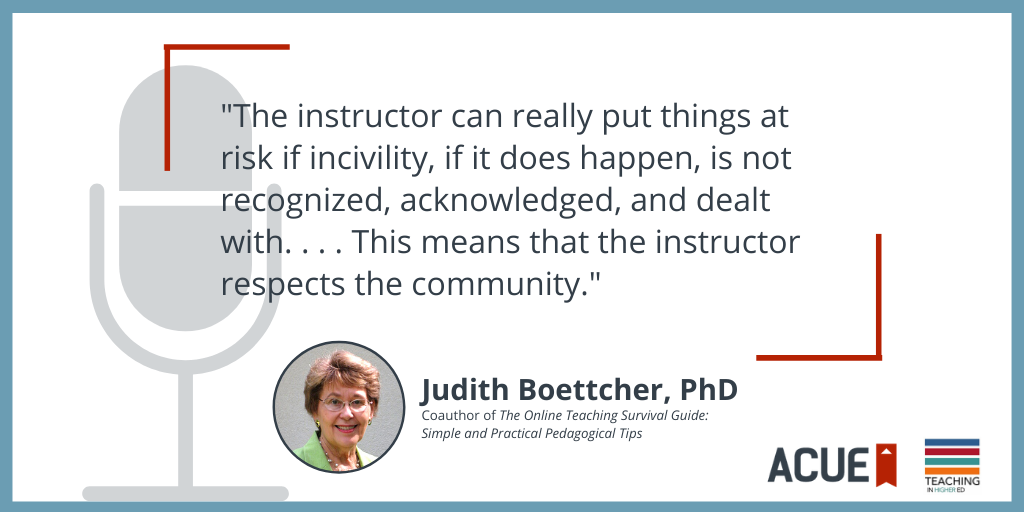
Expert Insights
Common Challenges & Misconceptions
Observe & Analyze
Minor disruption
Major disruption
After reading the discussion forum instructions and resulting student discussion for Dr. Ajmani’s Patient Advocacy Class, use the prompt below to discuss how effectively Dr. Ajmani responded to the minor disruption in the online discussion.
Discuss
Consider the following prompt:
How did Dr. Ajmani effectively handle the minor disruption in the discussion forum? What impact do you think his intervention had on the Sandy and what impact did it have on the rest of the class? How do you typically handle minor disruptions in discussion forums?
Discussion Forum Instructions
Professor Ajmani:
Dear Patient Advocacy Class,
As we discussed last week, 33 states have legalized medical marijuana. We learned that in order to use medical marijuana legally in these states, an individual must have one or more qualifying conditions (e.g., cancer, glaucoma, Crohn’s disease) and a health care provider must verify that an individual has this condition. When the health care provider verifies a qualifying condition, they are not recommending, nor are they prescribing medical marijuana. The health care provider is also not legally obligated to help the patient manage their use of medical marijuana.
In this week’s module, we’ll be looking at some of the ethical and policy issues related to medical marijuana prescription and use. Before we dive into the readings for this week, I’d like to start our exploration of this topic by hearing your perspectives on the following discussion question:
To what extent should health care providers be expected to help their patients manage their medical marijuana use?
Please post your response by 9:00 PM on Thursday, February 28.
Post from LeTetra Jones:
I think it’s great that patients suffering from different health conditions can find relief by using medical marijuana. However, like any drug, it is only effective if you use it the right way. I think doctors have a responsibility to help their patients use medical marijuana responsibly and effectively. I mean, they are the patient’s doctor and are supposed to be advocates for their health. If their patient is suffering from an ailment that can be helped by using marijuana, the doctor should fully support that.
Post from Sandy Park:
I think medical marijuana is kind of a sham. Medical marijuana is recreational marijuana with a different name. They’re the SAME thing! Medical students don’t learn about how to help patients manage their crack or meth use. So why would they help patients figure out how to manage POT? It just makes no sense to me.
Post from Professor Ajmani:
Hi all! I wanted to take this opportunity to remind everyone about our community norms. As you’ll remember, at the beginning of the semester, we decided that we would demonstrate respect for differences of opinion in our posts. We agreed that this respect was one of the main pillars that supports an inclusive and productive learning environment. Sandy, in the future, your posts should honor this agreement.
I’d also like to anchor our discussion in the content we covered this week. Sandy, while your comment suggesting that medical and recreational marijuana are the same thing is a valid opinion, the article we read on regulatory evidence suggests that medical and recreational marijuana are, in fact, very different products.
Remember, as we read last week, medical marijuana exists in a space that is often highly regulated. This means that products must be lab tested and include product labels that specify, for example, the amount of THC and CBD a given product contains (these are both common compounds in medical marijuana).
Knowing the profile of products (e.g. high-THC, low-CBD; High CBD, low-THC, equal parts THC and CBD) can help patients systematize their symptom management because it helps them predict symptom relief. For example, after one month, a patient determines that a tincture high in CBD and low in THC is the most effective for treating their inflammation. If this tincture is out of stock, the patient can look for another product with a similar THC/CBD profile.
Please see the attached resources related to medical marijuana regulations by state and product label requirements.
I look forward to hearing what the rest of you have to say!
After reading the discussion forum instructions and resulting student discussion for Dr. Ajmani’s Patient Advocacy Class, use the prompt below to discuss how effectively Dr. Ajmani responded to the major disruption in the online discussion.
Discuss
Consider the following prompt:
How did Dr. Ajmani effectively handle the challenging posts from Rae Lee in the discussion forum? What impact do you think his intervention had on Rae Lee and what impact did it have on the rest of the class? How would you have handled this situation?
Discussion Forum Instructions
Professor Ajmani:
Dear Patient Advocacy Class,
As we discussed last week, 33 states have legalized medical marijuana. We learned that in order to use medical marijuana legally in these states, an individual must have one or more qualifying conditions (e.g., cancer, glaucoma, Crohn’s disease) and a health care provider must verify that an individual has this condition. When the health care provider verifies a qualifying condition, they are not recommending, nor are they prescribing medical marijuana. The health care provider is also not legally obligated to help the patient manage their use of medical marijuana.
In this week’s module, we’ll be looking at some of the ethical and policy issues related to medical marijuana prescription and use. Before we dive into the readings for this week, I’d like to start our exploration of this topic by hearing your perspectives on the following discussion question:
To what extent should health care providers be expected to help their patients manage their medical marijuana use?
Please post your response by 9:00 PM on Thursday, February 28.
Post from Charlotte Glover:
I actually think that doctors should not be expected to provide any advice around the use of medical marijuana. I mean, that’s not what they went to school for. They learned about prescription drugs that are on the market, and how to prescribe them for various symptoms and conditions. Unless knowing about marijuana and understanding how to prescribe it is part of getting a medical license, I don’t think doctors should be going anywhere near the topic. Personally, I think that any attempt to help manage marijuana use verges on unethical practice because they’d be making recommendations about something they haven’t received any training on.
Post from Jerome Jenkins:
Charlotte makes a good point related to training. I don’t ask a mechanic how to bake a cake, so why would I ask a doctor how I should use marijuana? So where does this leave patients?
I think patients with previous experience using marijuana (before they started experiencing symptoms from cancer or glaucoma, for example) are in a better spot than people who have haven’t used marijuana before. Recreational users probably know how it affects them and have an idea of how it could help (or not) with things like pain. But this leaves novice users in the dark…I’m not sure who they would go to.
As an aside, I also agree with Sandy…no matter how we label marijuana, it’s still marijuana. Even though cigarettes might help alleviate anxiety, there’s never been a medical program to help smokers use cigarettes to manage anxiety. I think a “medical marijuana” program makes as much sense as a “medical cigarette” program. What’s next, “medical crack” for strung out crackheads in the hood?
Reply to Jerome from Professor Ajmani:
Jerome, I appreciate your perspective that medical programs should not involve recreational drugs. However, you may have missed my last post where I reminded everyone to abide by our community norms. I don’t think your last sentence really adds to the civility of our conversation.
Post from Rae Lee:
I have to agree with Sandy and Jerome. Just because we refer to it as, “medical,” doesn’t mean it’s any different than any other type of marijuana. I’m not sure why doctors would be getting involved in managing marijuana use unless someone is abusing it. Doctors should treat it just like alcohol use. If someone is abusing it, then doctors need to step in, but they don’t need to step in to help people manage their pot use.
Post from Neil Patel:
I don’t think it’s always the case that novice users are “left in the dark.” I would appreciate it if people didn’t make these types of sweeping generalizations based on little to no real-life experience.
My Aunt has a medical marijuana card and had never used marijuana before she was diagnosed with cancer. I’m her designated care giver and I go with her to the dispensary. The staff that work there are incredibly helpful. FYI – the dispensary is the place where everyone with a medical marijuana card can get medical marijuana products (at least that’s how it works in my state).
She was really nervous (and so was I!) when we first went. She was hesitant because she always associated marijuana with riff-raff. Once we got there, I thought she was going to wheel herself right out of there because the smell was so intense. But the dispensary staff were personable and helpful.
They suggested a transdermal patch with half CBD (the non- psychoactive cannabinoid) and half THC. It works, doesn’t smell, and she doesn’t have to smoke or ingest it (this is important because she has throat cancer). Based on my experience, I don’t think doctors should be recommending how to use medical marijuana when there are highly trained and qualified staff who can help with this at the dispensaries.
Post from Rae Lee:
Patel, I am sorry about your Aunt, but it seems seriously irresponsible of you as her caretaker to put her well-being in the hands of a bunch of druggies at these dispensaries. I doubt they have a college education, let alone a medical education. What were you thinking?????
Post from Professor Ajmani:
Hi everyone. We need to pause this conversation for a minute. I appreciate that this is a challenging topic and many of you have strong opinions about it. However, it is critical for our learning community that we listen and try to understand perspectives that differ from our own. By acknowledging and understanding all sides of an issue, we are in a better position to make informed decisions and recommendations. These are critical skills for your personal and professional development. This is why we spent time at the beginning of this course to create and agree upon a set of norms that enable us to have challenging, yet respectful and productive conversations. Direct attacks on another student (i.e. belittling their ideas or character), name-calling, and stereotyping do not lend themselves to conversations in which people feel welcome to share their thoughts without risk of ridicule or attack.
Before we move forward in this discussion, I ask that each of you revisit our Community Norms discussion forum, along with your written commitment to uphold them.
So, let’s take a step back and try this again.
Private email from Professor Ajmani to Rae Lee:
Hi Rae Lee,
I wanted to check in about our discussion forum this week. I can see you feel strongly about this issue and I’m wondering if you are okay?
In any case, you really have no idea what hardships Patel may be going through with his aunt, and it was completely out of line to criticize him. I believe you owe him an apology.
I expect that moving forward you will abide by our community norms.
Please let me know if you would like to discuss this further. Otherwise, I’ll look forward to a thoughtful, research-informed discussion post from you this week.
Implementation Resources
Online Instructional Practices
F2F Instructional Practices
This section includes resources to support your implementation of the practices presented in the module.
Download the online instructional practice implementation resources for this module.
Set expectations that promote civility
Set clear civility and netiquette guidelines in your syllabus
Setting policies addressing course conduct, including them in your syllabus, and reviewing the policies with your students as part of your online orientation are key to establishing expectations for civility. Be sure to check with your institution about any required language you may need to include.
Download a resource on setting clear civility and netiquette guidelines in your syllabus.
Netiquette guidelines address communication behaviors that are particular to an online environment. Include these basic guidelines in your syllabus to set the tone for online participation expectations.
Download a resource on netiquette guidelines.
Model and reinforce civil behaviors and professional expectations
Just like in a classroom setting, instructor behaviors can have a big impact on the online course environment (Boettcher & Conrad, 2016; Nilson & Goodson, 2018; Palloff & Pratt, 2007; Stavredes, 2011). The online environment can leave a lot of room for conjecture; therefore, it is important to be conscientious about the various ways you communicate and model civility. The online environment is also a good place to connect expectations with the professional behaviors students will most likely be expected to exhibit in the work environment.
Download a resource on modeling and reinforcing civil behaviors and professional expectations.
Collaborate with students to create community norms
Engaging students in a discussion about online communication norms and guidelines at the very beginning of a course is an essential step in fostering community and creating a productive learning environment (Boettcher & Conrad, 2016; Palloff & Pratt, 2007; Stavredes, 2011).
Download a resource on collaborating with students to create community norms.
Effectively respond to varied levels of challenging student behavior
Effectively respond to minor disruptions
Minor disruptions include behaviors such as posting off-topic comments, writing in all caps, using sarcasm, etc. Usually this behavior is unintentional, but you should reassure students that you are paying attention and are committed to ensuring a productive learning environment. You also want to ensure the offending student remains engaged.
Download a resource on effectively responding to minor disruptions.
Effectively respond to major challenges negatively impacting the learning environment
Major disruptions include such behaviors as direct attacks on what another student wrote and insults or offensive remarks towards the instructor or other students, among others. Instructors should immediately reach out to the offending student to discuss their concerns. These behaviors also require a response to the full group and, if the disruption involved an insult or attack on another student, a follow up with that student is in order as well.
Download a resource on effectively responding to major challenges.
Coach students to manage challenging conversations
Look for teachable moments to help students learn how to address challenges with fellow classmates. Small group work and communication missteps in both live and asynchronous discussions may lead to tension between students. If these arise, there is an opportunity to coach students to help them gain skills to effectively address their concerns with their classmates. This skill will also serve them well in their future.
Download a resource on coaching students to manage challenging conversations.
This section includes additional resources to support your implementation of these and similar practices in a face-to-face course.
Implementation Resources
Download or print the following resources to practice our techniques for promoting a civil learning environment:
- Use the instructor behaviors chart to determine ways that you could be impacting your classroom civility.
- View sample policies addressing classroom conduct that you can include in your syllabus.
- Learn about how to include your students in developing classroom norms.
- Use this planning chart to manage low-level interruptions in your courses.
- Review techniques for addressing low-level interruptions in a poised and positive manner.
- Learn about the difference between evaluative and descriptive language. You can also review examples of how to transform evaluative statements into descriptive statements.
- Use techniques for addressing midlevel interruptions to decrease disruptive behaviors.
- Learn about how to structure student conferences to effectively address high-level interruptions.
- Use the FICA planning tool to prepare for and hold conferences with students exhibiting highly disruptive behaviors.
References
INSTRUCTOR CREDENTIALS
Tracy Burt, EdM
Instructor
Child Development and Family Studies Department
City College of San Francisco
Jennifer Embree, DNP, RN, NE-BC, CCNS, FAAN
Clinical Associate Professor
Department of Community and Health Systems
Indiana University-Purdue University Indianapolis
Magnet Coordinator
Eskenazi Health
Angel Herring, PhD
Associate Professor of Child and Family Sciences
School of Child and Family Sciences
The University of Southern Mississippi
Darvelle Hutchins, MBA, MA
Doctoral Candidate
Department of Communication
University of Missouri
Kevin Kelly, EdD
Lecturer, Department of Equity, Leadership Studies and Instructional Technologies
San Francisco State University
Kate Kelley, PhD
Visiting Assistant Professor
Director of Undergraduate Studies
Department of Religious Studies
University of Missouri
Katherine McCarthy, PhD, LCSW
Assistant Professor
Indiana University School of Social Work
Deninne Pritchett, PhD
Chairperson and Faculty Member
Department of Psychology
Central Piedmont Community College
EXPERT CREDENTIALS
Judith V. Boettcher, PhD
Founder and Principal, Designing for Learning
Author, The Online Teaching Survival Guide: Simple and Practical Pedagogical Tips and Faculty Guide for Moving Teaching and Learning to the Web
Blogger, Thoughts on Teaching at http://designingforlearning.info/tips/
MODULE REFERENCES
Alberts, H. C., Hazen, H. D., & Theobald, R. B. (2010). Classroom incivilities: The challenge of interactions between college students and instructors in the US. Journal of Geography in Higher Education, 34(3), 439–462.
Bayer, A. E. (2004). Promulgating statements of student rights and responsibilities. New Directions for Teaching and Learning, 2004(99), 77–87.
Black, L. J., Wygonik, M. L., & Frey, B. A. (2011). Faculty-preferred strategies to promote a positive classroom environment. Journal on Excellence in College Teaching, 22(2), 109–134.
Boettcher, J. V., & Conrad, R.-M. (2016). The online teaching survival guide: Simple and practical pedagogical tips (2nd ed.). Jossey-Bass.
Braxton, J. M., Bayer, A. E., and Noseworthy, J. A. (2004). The influence of teaching norm violations on the welfare of students as clients of college teaching. New Directions for Teaching and Learning, 2004(99), 41–46.
Buttner, E. H. (2004). How do we “dis” students?: A model of (dis)respectful business instructor behavior. Journal of Management Education, 28(3), 319–334.
Conrad, R.-M., & Donaldson, J. A. (2011). Engaging the online learner: Activities and resources for creative instruction. Jossey-Bass.
Darby, F., & Lang, J. M. (2019). Small teaching online: Applying learning science in online classes. Jossey-Bass.
Davis, B. G. (2009). Tools for teaching (2nd ed.). Jossey-Bass.
Galbraith, M. W., & Jones, M. S. (2010). Understanding incivility in online teaching. Journal of Adult Education, 39(2), 1–10.
Knepp, K. A. F. (2012). Understanding student and faculty incivility in higher education. The Journal of Effective Teaching, 12(1), 32–45.
Nilson, L. B. (in press). Teaching at its best: A research-based resource for college instructors (4th ed.). Jossey-Bass.
Nilson, L. B., & Goodson, L. A. (2018). Online teaching at its best: Merging instructional design with teaching and learning research. Jossey-Bass.
Nilson, L. B., & Jackson, N. S. (2004). Combating classroom misconduct (incivility) with bills of rights. Fifth Conference of the International Consortium for Educational Development. Ottawa, ON, Canada.
Paff, L. (2015, September 28). Why policies fail to promote better learning decisions. Faculty Focus. http://www.facultyfocus.com/articles/effective-classroom-management/why-policies-fail-to-promote-better-learning-decisions/
Palloff, R. M., & Pratt, K. (2007). Building online learning communities: Effective strategies for the virtual classroom (2nd ed.). Jossey-Bass.
Patterson, K., Grenny, J., McMillan, R., & Switzler, A. (2002). Crucial conversations: Tools for talking when stakes are high. McGraw-Hill.
Stavredes, T. (2011). Effective online teaching: Foundations and strategies for student success. Jossey-Bass.
Wilson, G. L. (2005). Groups in context: Leadership and participation in small groups (7th ed.). McGraw-Hill.